EN
You’re sitting on the balcony of a stucco building, overlooking a quiet neighborhood street. A warm breeze blows in the air. Children stumble over a football, calling after one another. They run past the trio of neighborhood elders, gathering at the same bench every evening for conversation. Two young boys walk by, strumming on an instrument. They sing. And above it all hangs a crimson, tangerine sunset. You are in Kutaisi, and although it feels like it could be a dream, this is a typical evening living with your host family.
I get it. If you’re like me, and you’re reading this blog, you were probably nervous to study abroad. Chances are, you’ve never been to this country before, and you are probably preparing yourself for a language you didn’t grow up speaking. The prospect of living with a host family can be daunting. Essentially, you are moving in with strangers. You don’t own the space, and you don’t control the schedule. There are so many variables, and you might not know what they are until you arrive. These are all things you’re told to consider when choosing your living situation– homestay, dormitory, or private apartment.
I was once in your shoes too. I had never been to Georgia before, and grew up mostly as an only child. I was always the type of person to choose a solo dormitory over a roommate, and liked to have my own space. I was the kind of person to spend my evenings alone, decompressing from the long day ahead. I had even completed a study abroad program previously where I had my own apartment, and enjoyed it. But today, I would never decide that for myself, and would choose a host family every time.
So, what changed my mind? It was the incredible experience I had staying with my host family in Kutaisi, Georgia. Here were the key moments that changed my perspective on travel, homestays, and why we study abroad at all.
1. There’s No Replacement for Language Immersion in the Home
When I studied in Kutaisi, I was studying both Russian and Georgian language. My daily classes consisted of Georgian language, and I had the opportunity to practice Russian while visiting museums and occasional interactions with locals. Of course, there’s value in both kinds of experiences– formal lessons provide you with grammar, text-book style. Everything is spelled out for you right away. Short daily interactions, such as those in supermarkets and restaurants, challenge your recall and listening skills. And yet, these two modes of engagement can’t replace the benefits of daily conversation.
Take, for example, the dinner table. In my host family, I had breakfast and dinner with my host sister and host mother daily. In the evenings, my host father joined us. Neither of my host parents spoke English, but that never stopped them from communicating with me. What started as pointing out basic dishes on the dinner table– khachapuri, mtsvadi, lobio, and so much more– transformed into sustained conversations. Meal time gave me the perfect environment to practice the content of my daily lesson, and gave me a space to make mistakes. With each mistake (and trust me, there were a lot!), my host family responded with excitement and encouragement. I received suggestions for how to improve my speech, and learned phrases that felt more natural than the grammatic, clunky vibes of textbook conversations.
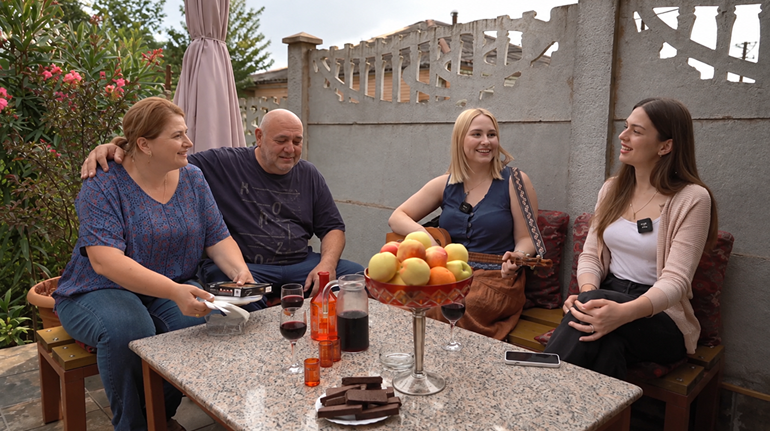
Most importantly, though, my host family gave me space to listen. While doing homework at the dinner table, I would hear my host mother speak on the phone with a relative. When my host sister’s cousin came to visit, I was able to sit in on the conversation. Rather than sit alone after school, I would sit in the living room and listen to the local news. Georgian absolutely surrounded me. And although it didn’t necessarily feel like I was learning, I was starting to understand through diffusion. I have a clear memory sitting on the couch with my host sister, looking up as I listened to a reporter on the news. When I translated the sentence back to my host sister, we were both shocked!
Another unexpected point of immersion came from our family pets. Having a dog, cat, or a parrot, as my family did, helped me recognize how to construct simple sentences. Through repetition, short words and phrases became ingrained in me, and ultimately, natural. I remember the moment my host sister approached the parrot, repeatedly calling out, “Zuko is a good boy!” Based on this sentence, I expressed my first full sentence in Georgian: “Keti is a good sister.” Those are the exact memories and connections you can’t access in the classroom or on the street alone.
2. When Travel Feels Isolating, Your Homestay is There For You
Besides a new language, studying abroad involves immersing yourself in a new culture. You might choose to pour over travel books and YouTube videos ahead of your visit, but there’s a reason we developed a phrase for “culture shock.” Beyond obvious things like language and daily interactions, even the mundane can suddenly feel foreign. Public transport. The weather. How to dress. How to start a conversation. Very suddenly, it can feel like everything changes, and none of the rules apply.
Although this is usually what motivates us to study abroad, there’s a real risk of feeling like an outsider. You might start to feel frustrated, or experience homesickness. When you choose to live in an apartment, you’re likely left alone with these feelings, which can make the isolation even stronger. If you choose to live in a dormitory, your roommates– likely other international students– are often in the same boat with you.
But with a host family, you don’t have to feel like an outsider. Your host family understands that you are new to this community, and that a little extra support can go a long way.
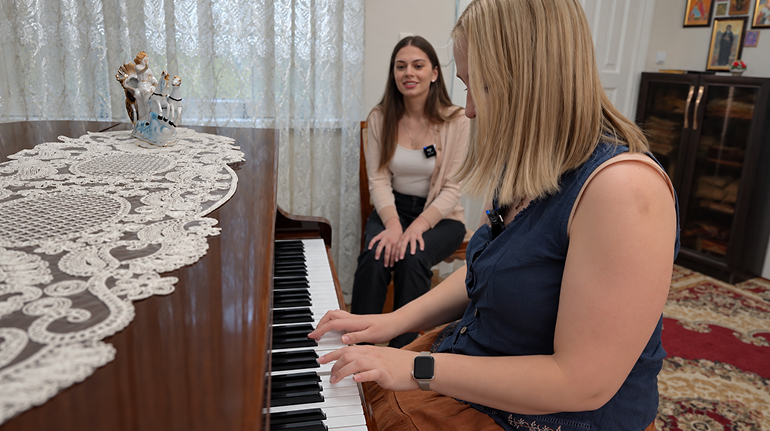
But, what if you’re not sure how to connect with your host family? What do you do then? Most likely, your interests are probably not so different from your host parents or host siblings. At first, I wasn’t sure how I would connect with my host sister. I knew she was younger than me, and grew up in Georgia her entire life. But after receiving a tour of the house, I noticed the family piano right away. I quickly learned that Keti had practiced piano since she was little. I did too. When I asked her to play a short piece for me, she ended up selecting the exact song I studied only several years before. For the next hour, we took turns at the piano, showing each other the songs we learned to play as children. When I expressed my interest in Georgian music, I had the chance to involve my host parents. As it turns out, my host father loved American rock music: the exact bands that I grew up listening to with my own dad.
As a student of Georgian folk music, the sound of the panduri instrument and local songs became the backdrop of our home. Whether on the porch outside, in the living room, or at the dinner table, my family bonded over music daily. I had the opportunity to show what I learned in my lessons, and learn the songs that my host parents grew up with. My ability to speak, listen to, and understand Georgian improved with my musical skills, and the connections between us grew deeper. This experience became the baseline of my academic research in the future– that in Georgia, music is meant to be shared.
No doubt, culture shock is intimidating. But daily interactions with your host family and bonding moments such as these remind us that we’re not so different from one another after all.
3. Nothing Beats A Homecooked Meal
It’s been a long day exploring your host city. You had a lesson in the morning, and you have a lecture and museum tour in the afternoon, so you decide to grab a quick lunch from a food stand in the city center. After the day's events, you walk home, and you realize that you’ve been out for hours.
Imagine you chose the solo apartment. What’s your next task? To cook dinner. Exhaustion is real, and sometimes, dinner is the last thing you want to worry about. Staying in a host family takes care of that problem immediately. There’s no need to stress about figuring out your own groceries, what recipes to try, or if your favorite dish will taste the same so far away from home.
Host families also understand that sometimes, food is the best way to get to know your surroundings. You can expect to try a variety of local cuisine, especially some of the lesser-known, but equally delicious dishes from your region. This was how I became introduced to my favorite Georgian food, jonjoli. In a world full of khachapuri and khinkali, foods like jonjoli often get overlooked. A picked flower, jonjoli was like nothing I had ever tasted before. And yet, I loved it.
Chances are, your host family will notice what you do like, and what you don’t like. Personally, I came to enjoy a steady supply of jonjoli at our dinner table. Aside from the convenience of a prepared meal, and the diversity at our table, however, I came to value the time at the dinner table more than anything. The established time to connect over food, so incredibly valuable in Georgian culture, reminded me of the meals I shared with family back home. When you feel like everything is changing rapidly around you, or start to miss your family and friends back home, a routine, home cooked meal can go a long way.
4. You Come to Understand Your Host Community the Way Locals See It
As you progress on your study abroad journey, you will start to feel like you have an understanding of the environment around you. Foreign language becomes more natural, and you start to feel like a member of the community yourself. And that’s the point when conversations with your host family start to become far more interesting.
Spending time with your family gives you a deeper glimpse of what it’s really like to live in your host community. What’s it like to attend elementary school? How about applying for college, or starting a new job? What do people do on weekends? What opportunities are there to engage in the arts? What’s unique about the local history, religion, or politics? These are the kinds of questions that structured classrooms and brief interactions don’t always tell you about. Choosing to engage in conversations with your host family on foreign topics– through listening, asking questions, and sharing your own perception– can develop into some of the most interesting and thought-provoking experiences during your study experience.
On the weekends, my host family loved to visit Orthodox monasteries, something that we don’t have in the United States of America. Through these visits, I became aware of local religious practices and histories that date back for centuries. These monasteries are far from the center of the city, and even the neighborhood we lived in. Without their insight and encouragement, I likely wouldn’t have visited these monasteries on my own accord. These visits not only showed me the importance of Orthodoxy in Georgian society today, but also how the Orthodox faith has shaped the Georgian kingdom since the first millennia. I had the opportunity to participate at my own comfort, something I would never do on my own accord in America, or even as a tourist.
Overall, life with a host family gives you a different perspective on the city and culture around you. You learn to read things as locals do, and consider how local and global events shape their experiences. These private conversations and rare opportunities, in addition to bringing you closer to your family members, bestow upon you a better understanding and appreciation of your host community and daily life.
5. Your Host Family = Family and Friends for Life
There is one moment of host family experience that nobody, and nothing, can ever prepare you for– saying goodbye. You may have chosen the host family option reluctantly at the start of the program, trying to push yourself to step outside the box. And by the end, you’re stuck wondering how you could ever leave. The daily conversations, routines, and laughter are a part of you, and your understanding of the host community. Your host siblings have become your new best friends, and your host parents have started to become like your own. You stand in the garden with your suitcase and passport, looking out at the same street you’ve seen from your bedroom balcony for the last six weeks. You hold back the tears as you embrace your new-found family, and start to wonder what life will look like again without them.
But, there’s good news. In the digital age, you never have to say goodbye. You’ve built the connections and skills that make returning to your host city in the future possible. You promise to come back, even if you’re not sure when, because you know that the bonds you’ve created are unbreakable. Your host family is never just your family for six weeks– they become your family for life.
I write this blog from my apartment in the city where I study. On my phone, I have a plane ticket to Tbilisi, where I will be in five days from now. I have the train schedule for Tbilisi-Kutaisi saved in my files. An uncertain future that felt like forever, is suddenly only a week away. As I promised, I will see my host family again. And I know that once you decide to choose a host stay for your study abroad program, you’ll want to make the trip back too.
- Continue Reading